Ye Olde Cheshire Cheese
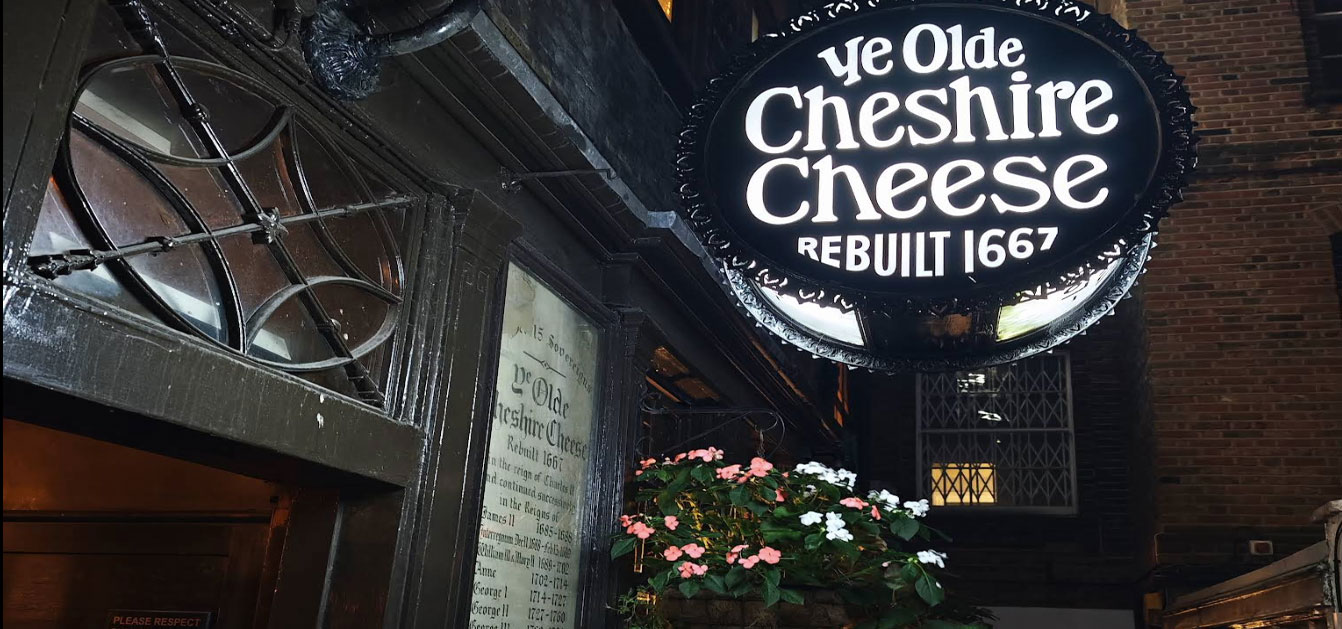
Ye Olde Cheshire Cheese
Ye Olde Cheshire Cheese, 145 Fleet Street, City of London, EC4A 2BU
Ye Olde Cheshire Cheese Today
The “Cheshire Cheese” in Wine Office Court is without doubt the finest of the City of London’s surviving historical taverns. The interior and extensive cellars running under Fleet Street have not changed for hundreds of years, it remains beautifully frozen in time. A visit to the ‘Cheese’ is a privilege that should be savoured and relished with a huge sense of history and comradery for those who have drunk and get drunk before you. Samuel Smith Brewery are the current custodians of the ‘Cheese’, they have kept the pub perfectly over what must be around 45 years. Cask Old Brewery Bitter is served from oak casks in the pub cellar, wines and spirits are also available. If you wished for the complete ‘Cheshire Cheese’ experience and dine as famous patrons have in the past, the ‘Cheese’ offers my personal favourite “Steak & kidney Suet Pudding”, truly a meal which benefits from at least two pints of Old Brewery Bitter.
Their website is here https://ye-olde-cheshire-cheese.co.uk/
Finding the ‘Cheese’
If you are walking up Fleet Street, that is heading towards St. Pauls, you want to be on the left-hand side of the
road. You are looking for a narrow lane off to the left, there is only a side entrance to the Cheshire Cheese that is Wine Office Court, number 145.
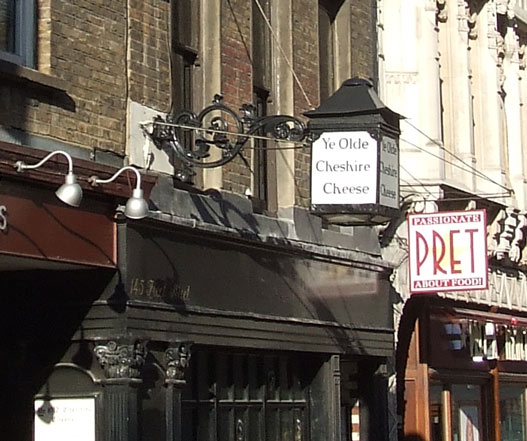
The White Sign is easily visible from anywhere on Fleet Street.
Ye Olde Cheshire Cheese Past
As you can imagine, with over 350 years of history there is plenty of the past to cover, I’ve selected the gems which I enjoy and hope you do too (bear in mind, as I have found, some history from the 17th century can seldom be stated as a fact. I have done my best to verify these).
There has been a pub at this location since 1538 shown on maps of the City, the building you see today dates from 1667 being destroyed and then rebuilt after the Great Fire of London. It is understood to be the very first building rebuilt after the Great Fire (marvellous if this is indeed true, it being a pub and all).
There is evidence that some of the Ye Olde Cheshire Cheese rooms were used for more than drinking and eating. Tiles depicting sexually explicit scenes were removed from a fireplace and given to the Museum of London in 1962. Suggesting that at least one room was used as a brothel in the mid-eighteenth century.
There is much written relating to strong literary associations with Ye Olde Cheshire Cheese; Oliver Goldsmith, Mark Twain, Alfred Tennyson, Sir Arthur Conan Doyle, G.K. Chesterton, P. G. Wodehouse and Samuel Johnson are all said to have been 'regulars'. Dr Samuel Johnson 1709-1784, The son of a bookseller, he became one of the greatest literary figures of the 18th century, most famously compiling A Dictionary of the English Language (1755). However, there is no recorded evidence that Johnson ever visited the pub, only that he lived close by, at 17 Gough Square.
Indeed, the London Daily News from Thursday 15th February 1900 published a letter from one Eugene Barnett, Savage Club, Feb 13th – Writes :
“The Cheshire Cheese”
Sir, - Thanks for the able review on Mr. Callow’s book in your issue of this day. On what authority, indeed, does he assert that the “Cheshire Cheese” was at any time frequented by Dr. Johnson, Dick Steele, Reynolds, or any of the other illustraimi of the period! Many years ago I hunted up most diligently every nook and corner of “Johnsoniana” and could not find this tavern mentioned anywhere.
I have read Volteiro’s account of his journey to England, and with the exception of the somewhat apoohryphal visitto Congreve, there is no evidence of his ever getting cast of Charing Cross, except in a fugitive visit to St. Paul’s or the Tower of London.
>On the other hand, there is some evidence that the “Cheshire Cheese” was extensively patronised by Fleet Market and Clare Market, butchers. Good gossiping Peter Cunningham, in his work on London, dismisses the “Old Cheshire Cheese” only as an excellent chop, and steak, and pudding house, and Leigh Hunt, the soul of bohemianism, who assuredly would have embraced the opportunity of giving one of his vivid pictures of intellectual social gatherings over the flowing punch bowl, never once mentions this ancient hostelry in that admirable work of his, “The Tower”.
Let Mr. Callow give us some facts. I venture to say that hill will not be able to do so – yours …”
It is worth mentioning the delightful staircase which leads from the ground floor to the upper rooms, although closed to climb today they are a magnificent example.
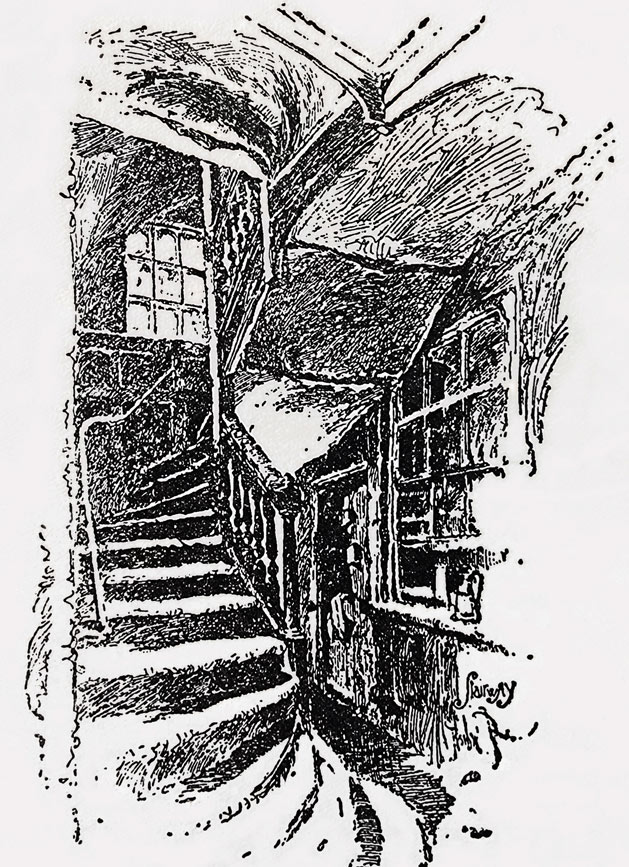
It is so easy to feel the steps that have ascended these stairs over the hundred of years they have been in place. This sketch by Herbert Railton (1857-1910).
The PuddingThere are many historical references to ‘The Pudding’, cooked and served in Cheshire Cheese as a special. Known as ‘Lark’ the savoury dish had a fine light crust and a filling of rump steak, kidneys, oysters, larks, mushrooms and as so often even today - secret spices and gravies. The filling was brought together in huge quantities, as much as 100 pounds in weight. Boiled together for more than 16 hours, it was said, the cooking aroma could reach the Stock Exchange. The pudding was produced for carving on Wednesday and Saturdays only.
Nearby Notables
Daily Telegraph Building
Just before you turn down Wine Office Court, look up at the Cheshire Cheese lantern and then focus on the Art Deco clock you see about 30m further down the road. This is 135-141 Fleet Street, the Daily Telegraph Building. Opened in 1929, to house the press offices & printing presses, eight storeys tall & seven windows wide, made from Portland stone & designed by Charles Ernest Elcock has been a Grade II listed building since 1983.
After the newspaper's relocation in the 1980s, the building housed Goldman Sachs' European headquarters until 2019. In 2021, plans were announced for a ?90 million redevelopment to create 300,000 square feet of grade-A office space.
Salisbury Square Development
Works directly opposite 135-141 Fleet Street are being carried out by the Mace Group to facilitate the redevelopment of Salisbury Square into the new City of London ‘Cyber Courts’, there client is The City of London, works commenced October 2021. A centre for His Majesty’s Courts and Tribunal Services combining all but the Old Bailey into one location. It will also be new headquarters for the City of London Police. Work is expected to be completed by 2026.
you stand facing Wine Office Court with your back on Fleet Street as if you were heading to the most delightfully historically significant pub in the City of London. Look at the second building on your right-hand side. This was, until 2008 King & Keys pub (142 Fleet Street). The name is derived from the amalgamation of two licences of separate former pubs, the Cross Keys and the Three Kings. The carved work between the 1st and 2nd floor with the words Kings & Keys was sculpted by Sir George Frampton (1860-1928), one of the major figures associated with the New Sculpture movement. He was known for combining unusual materials in his work, mixing components such as marble, bronze, ivory, glass and precious stones. Now sadly spoiled when the whole building front was painted over in 1995 in green.